Check out what executives across America are using to gain insight about the next generation.
The only thing constant in the 21st century is CHANGE!
How to sell, manage, empathize and communicate in a multi-generational workforce.
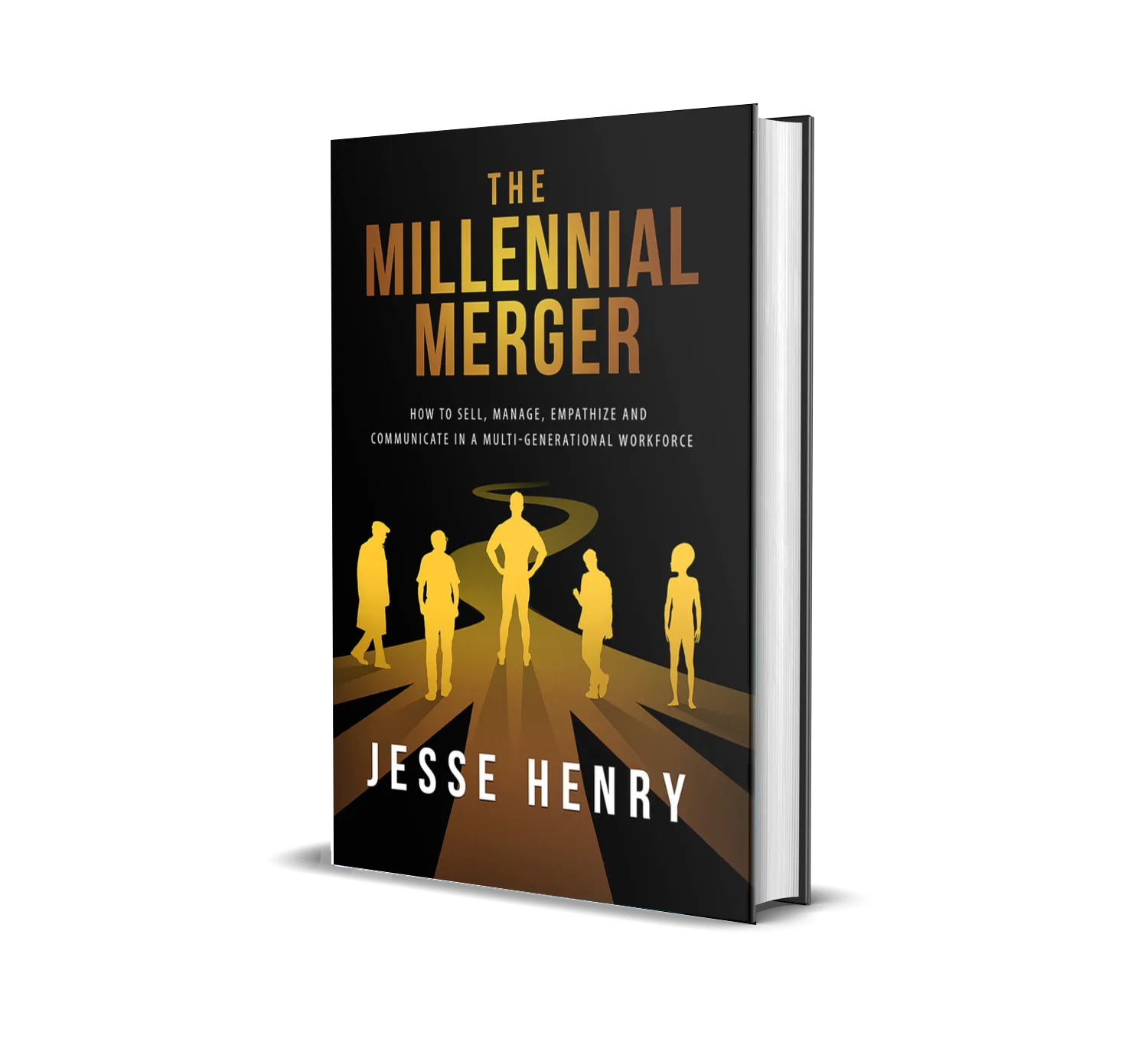
Millennials are driving cultural shifts in religion, politics, and the private sector as we know it. The question is, are you ready for the generational revolution taking place?
This book challenges traditions from our past as the new generation takes hold of their own belief systems. Since we no longer mindlessly adopt the teachings of our parents, older generations are sitting there wondering, “what’s next?”
This book will help you think more independently, and see the world from a holistic perspective. In the age of technological abundance, it’s multiple (relevant) perspectives that will help us implement necessary changes.
The Millennial Merger Is…
- A guidebook outlining millennial philosophical shifts.
- A wake-up call to executives who are frustrated with their lack of results across their multi-generational workforce.
- A secret weapon to adapting to the inevitable 21st-century cultural nuances.
The Millennial Merger Is Not…
- “the millennial way is the right way.”
- A book that talks about ALL the things millennials do right, and NONE of the things they do wrong.
- A fixed ideology that will stay consistent over the next century.

Meet the author
Jesse Henry
Entrepreneur. Investor. TEDx Speaker. Lifelong Learner. Advisor to Few. Friend to Many.
Jesse Henry is on a journey to create global impact. He left the self-development industry for finance so that he could better leverage his business acumen and communication skills.
Ever since high school, he aspired to sit at the intersection of the economy. Although he didn’t know what the destination looked like, he set off in college to work with leaders across all industries.
Jesse graduated from Florida State University with a degree in Entrepreneurship and Professional Sales. During his time at FSU, Jesse started up 2 companies and created 2 student organizations to catalyze the FSU entrepreneurial ecosystem. His speech at TEDx FSU is what propelled him toward a future of endless opportunity. Jesse’s career trajectory has not always been crystal clear. For years, Jesse struggled to align his passions and find the proper teams to work with. Many of the concepts in this book came about from his perceptions of operational inefficiencies throughout corporate America.
Jesse’s tool belt comes from working with Tony Robbins, Oren Klaff, and dozens of other mentors who provided a philosophical foundation for Jesse to create his perspective.
Jesse’s commitment to society transcends “impact” and “financial abundance”. He has a vision of what the world can look like, and he’s going to stop at nothing to make it happen.
Jesse currently resides in Scottsdale, Arizona, where he is working on his startup investment firm, Cloud Nine Capital.
What readers and founders say
“Jesse Henry is a top thought leader for the millennial generation. This book will give anyone an insight to the millennial ideologies that will continue to shape organizations over the next half century. Jesse’s perspective is something the public and private sector will benefit from for decades to come.”
“This is a must read for any company who is serious about getting the most out of their millennials. Jesse demystifies the history, motives, and aspirations of this generation upon which we all depend. His granular analysis gives us the keys to attracting, engaging and empowering millennial “partners” by first gaining their respect and their trust. His insights are spot on, easy to understand and easy to apply.”
Quotes from the book
On Empathy…
“We can only challenge our perspective of society by seeking to understand how others view the world. It’s only then that we can determine whether their ideology is a perspective worth adopting.”
On Identity…
“At the core of the millennial ideology is the concept of individualism.”
On The Dangerous Path…
“In 21st-century business, the seven most dangerous words are: “because that’s how it’s always been done.””
On Decision Making…
“If you include the millennials in the decision-making process, you’re guaranteed to gain insight you would have never had otherwise.”
On Interconnectivity…
“We’ve become so connected with the world around us that we’ve become exponentially disconnected with ourselves.”
On Individuality…
“We aren’t one of seven billion. We are one of one.”
On Political Correctness…
“Regardless if we agree with another’s perspective, political correctness is the largest form of mental oppression.”
On Social Constructs…
“Traditions create social constructs about what life should be, based on what was.”
On Challenging Traditions…
“If we never challenge the traditions from our past, how are we supposed to advance and grow as a society?”
Stats that make millennials unique
It’s easy to call millennials out for being different, or creating disruption across industries, politics, and culture. But it’s important to understand why this generation thinks about the world so differently.
- 90%
of freelancers surveyed say being an entrepreneur is a mindset, not starting a company. Millennials were a subgroup of that survey.
Source: oDesk and Millennial Branding, 2013
- 87%
of managers surveyed who moved into a management role between 2008 and 2013 were Gen Y (millennials). The figure was 38% for Gen X and 19% for boomers.
Source: EY, 2013
- 54%
of young Americans ages 18 to 34 want to start a business or already have started one.
Source: Kauffman Foundation and Young Invincibles, 2011
Frequently asked questions
The questions readers ask most, answered from the book. Each answer is a summary, not a passage.
It explains how millennials think about work, money, belief and leadership, and why those views differ from the views of earlier generations. The goal is understanding. Leaders get more out of a mixed-age team when they know what each group values.
Executives and managers who lead people from more than one generation. It is also for anyone who wants to understand why younger colleagues see work, status and institutions differently.
The book says no. Many millennials leave jobs because they are not engaged, not because they are poor workers. Some have little drive, and some overwork themselves. The useful question is what each person needs to do their best work.
The book lists common causes: values that clash with the company, no room for life outside work, no link to a larger purpose, no path to lead, weak training, no feedback, and feeling unheard. Turnover is also expensive. Replacing a person costs more than keeping a good one.
Yes. The book describes a generation that wants to take part rather than wait to be told. Including the people closest to the work in decisions often surfaces insight that leaders would otherwise miss.
No. Money tends to amplify who a person already is. It can help people grow and can change lives, but it does not fix a problem that comes from within. Chasing a bigger number usually means the next problem arrives sooner.
Ambition is a strength with a cost. The book asks readers to check whether their pace leaves room for health and happiness, because burnout is real. Big goals are worth pursuing. The price of pursuing them should be counted in advance.
The book treats belief as a personal philosophy. It argues that organized systems often split people into us and them, and it encourages readers to form their own views rather than inherit them. These are the author’s views, meant to be examined and debated.
The book argues that the value of flexibility is trust, not the policy itself. Small gestures, like a half day on summer Fridays or working from home a day or two a week, tell people that you care about their well-being as much as the company’s. It also says not everyone does their best work from nine to five.
Clear standards, honest feedback, a purpose they can see, and a chance to grow. The book argues that leaders who set standards and explain the reasons behind them get better results than leaders who manage by mood.
The book says meetings with no value for the people in them are one of the fastest ways to lose engagement. Invite only the people who need to be there, and say what the meeting is for.
No. The book argues that millennials are neither better nor worse than the generations before them. Every generation is shaped by its own moment, and the author asks older readers to look at the differences with curiosity rather than dismissal.
The title points to combining perspectives, not choosing one generation’s way over another. The book’s argument is that the answers to change come from several viewpoints working together.
Contact
Questions about the book, speaking, or the work. Messages go to hello@altlaboratories.com.
The only thing constant is change.
This book will help you think more independently, and see the world from a holistic perspective.